
Score a scale and check its reliability
Source:vignettes/articles/docs/methods/scales-reliability.Rmd
scales-reliability.RmdThese methods give a scale’s score and test whether its items hold together.
Assumptions. Use items that measure 1 idea, with reverse-worded items scored back. Alpha assumes items contribute equally, omega does not.
In SurveyStudio, open Plan on the Design screen, add a research question and choose the method. Choose the scale. Its items, shared answer set and reverse-scored items come from the scale defined on the Design screen. Declare the hypotheses and the decision rule before collecting responses.
Scale score descriptive statistics
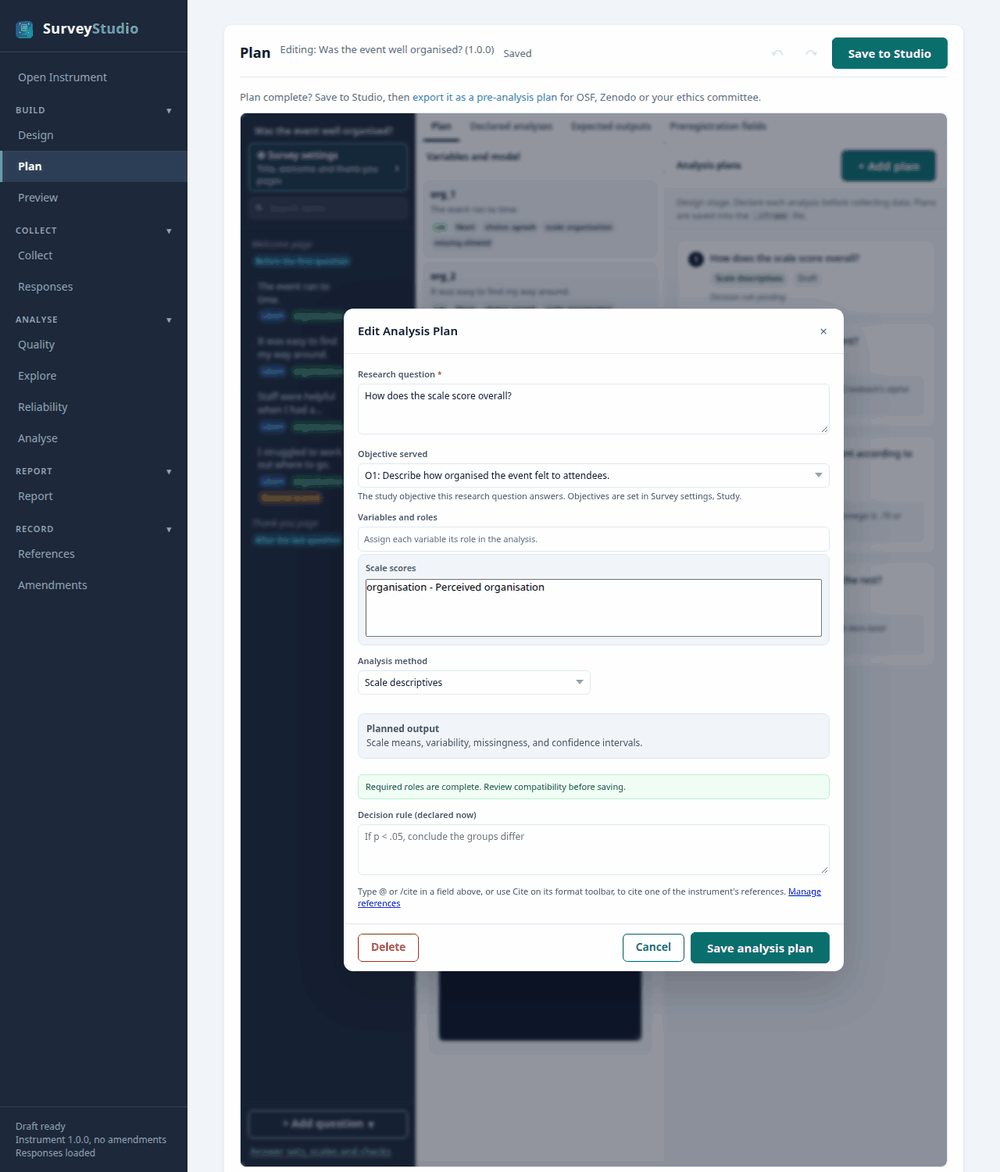
likert_scale demo.In the pre-analysis plan:
RQ1. How does the scale score overall?
In the report: the APA 7 sentence and a table, with a chart where the method has one, each titled with the research question.
Cronbach’s alpha (internal consistency)
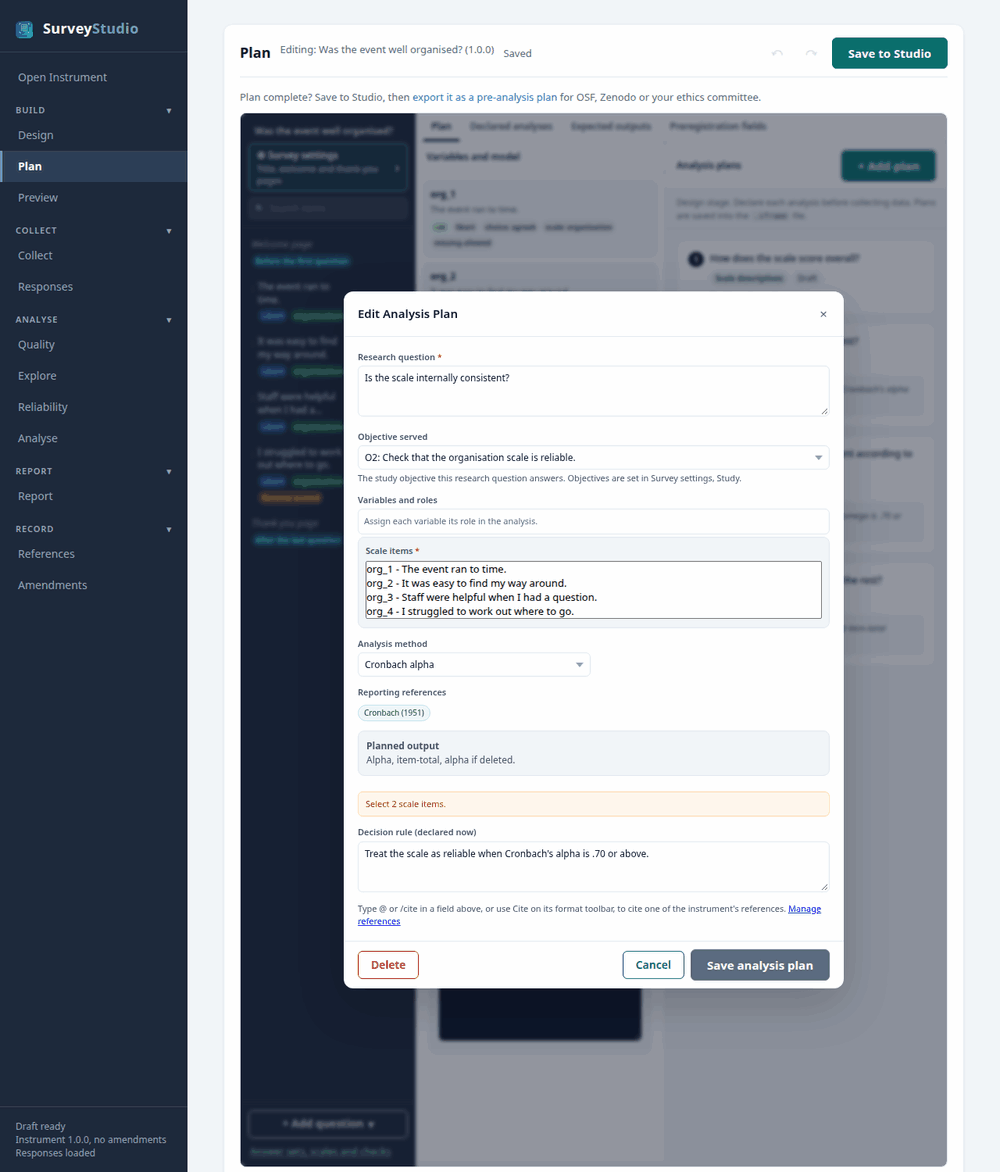
likert_scale demo.In the pre-analysis plan:
RQ2. Is the scale internally consistent? Planned decision rule: Treat the scale as reliable when Cronbach’s alpha is .70 or above.
In the report: the APA 7 sentence and a table, with a chart where the method has one, each titled with the research question.
References: Cronbach, L. J. (1951). Coefficient alpha and the internal structure of tests. Psychometrika, 16(3), 297-334.
McDonald’s omega (internal consistency)
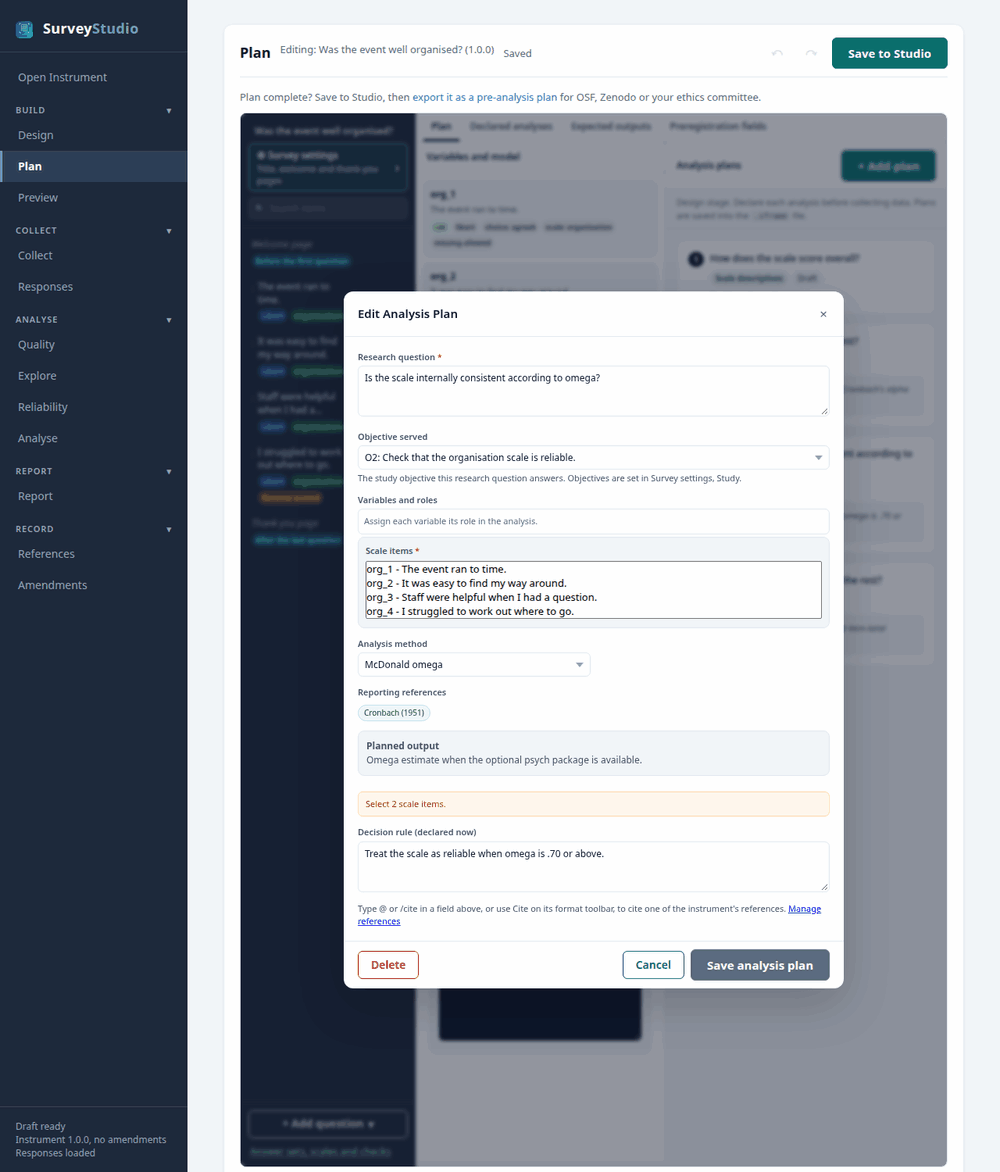
likert_scale demo.In the pre-analysis plan:
RQ3. Is the scale internally consistent according to omega? Planned decision rule: Treat the scale as reliable when omega is .70 or above.
In the report: the APA 7 sentence and a table, with a chart where the method has one, each titled with the research question.
References: Cronbach, L. J. (1951). Coefficient alpha and the internal structure of tests. Psychometrika, 16(3), 297-334. McDonald, R. P. (1999). Test theory: A unified treatment. Lawrence Erlbaum.
Item diagnostics
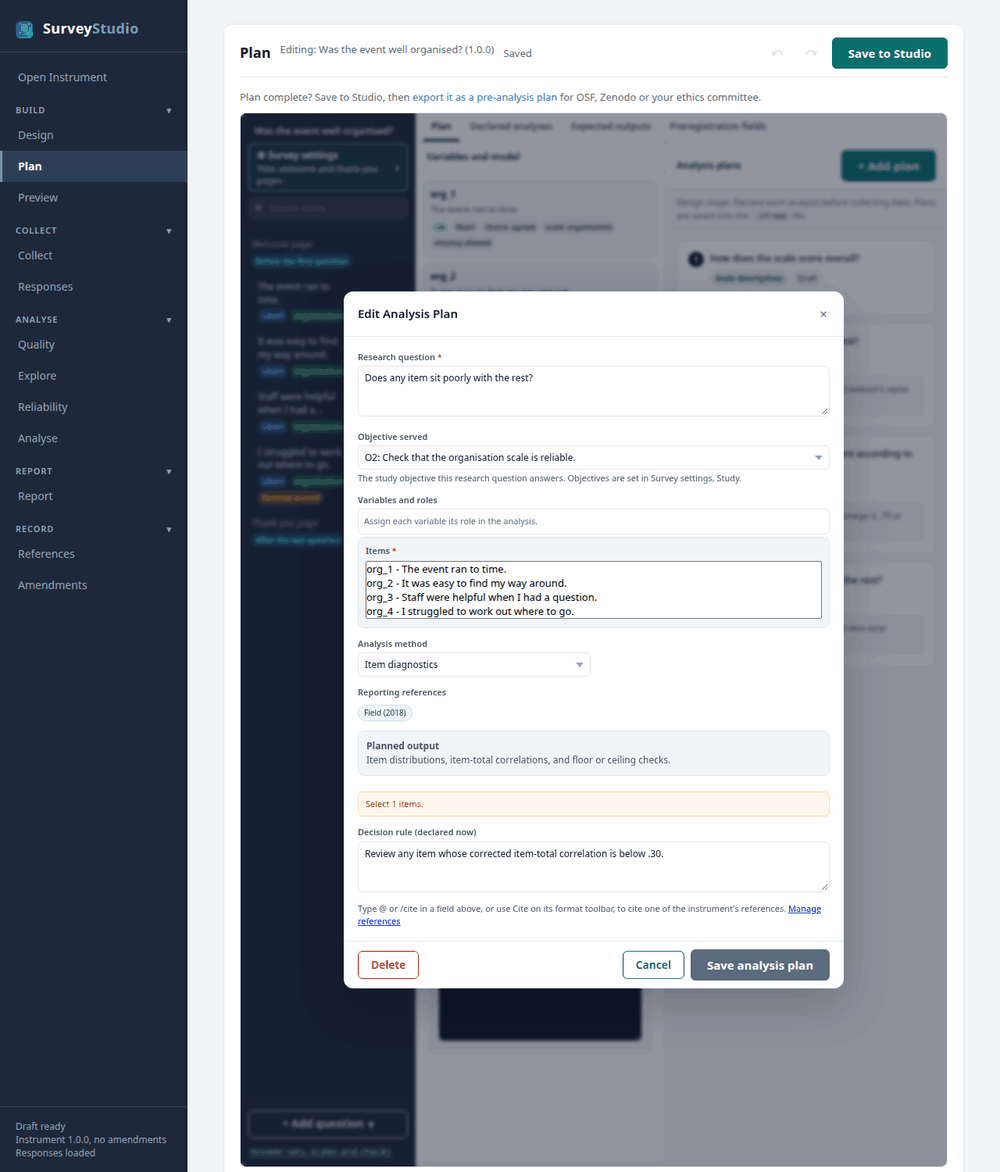
likert_scale demo.In the pre-analysis plan:
RQ4. Does any item sit poorly with the rest? Planned decision rule: Review any item whose corrected item-total correlation is below .30.
In the report: the APA 7 sentence and a table, with a chart where the method has one, each titled with the research question.